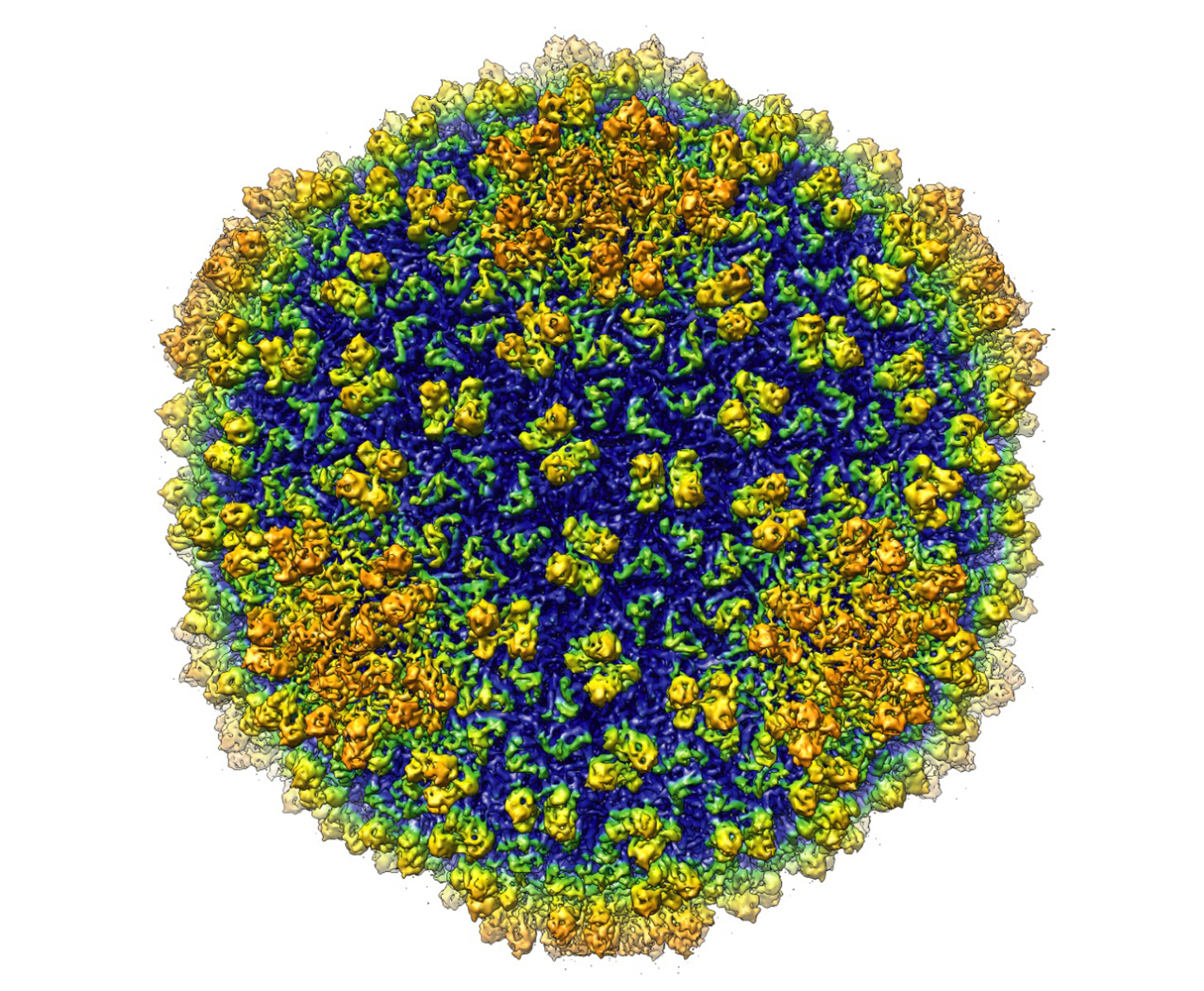
U.S. researchers have used a new technique named cryo-EM (short for ‘Electron cryomicroscopy) to capture images of a virus at a resolution of 4.5 angstroms — less than half of a nanometer. As said the lead researcher, ‘This is the highest resolution ever achieved for a living organism of this size.’ The team thinks this should help to develop new disease treatments. Of course, this kind of research has a cost. It requires high-end electron microscopes and powerful computing resources. The next microscope used for this project will be installed in 2009 for a cool $2 million. And in order to generate the 3-D images at this very high resolution with their current microscope, the research team used the power of 7,000 computers at Purdue University. But read more…
You can see above an image of the bacteriophage Epsilon15 studied by Wen Jiang. On the left, the bacteriophage which has approximative diameter of 700 angstroms is shown at a resolution of 4.5 angstroms — the highest resolution achieved for a living organism of this size. On the right are shown “seven subunits in an asymmetric unit, annotated in different colours. Each subunit contains one copy of [baseplate proteins gp7 and gp10″ (Credit: Wen Jiang lab, via Nature). Here is a link to a larger and better version of the image on the top left.
This research project has been led by Wen Jiang, an assistant professor in the Department of Biological Sciences at Purdue University, and members ofhis research group. “In addition to Jiang, Matthew L. Baker, Joanita Jakana and Wah Chiu from Baylor College of Medicine, and Peter R. Weigele and Jonathan King from Massachusetts Institute of Technology worked on the project.”
Now, let’s look at the advantages brought by the cryo-EM imaging technique. “The imaging technique, called cryo-EM, has the added benefit of maintaining the sample being studied in a state very similar to its natural environment. Other imaging techniques used regularly, such as X-ray crystallography, require the sample be manipulated. ‘This method offers a new approach for modeling the structure of proteins in other macromolecular assemblies, such as DNA, at near-native states,’ Jiang said. ‘The sample is purified in a solution that is very similar to the environment that would be found in a host cell. It is as if the virus is frozen in glass and it is alive and infectious while we examine it.’”
And why is this imaging technique different from other ones currently used? “In electron microscopy, a beam of electrons takes the place of the light beam used in a conventional microscope. The use of electrons instead of light allows the microscope to “see” in much greater detail. Cryo-EM cools specimens to temperatures well below the freezing point of water. This decreases damage from the electron beam and allows the specimens to be examined for a longer period of time. Longer exposure time allows for sharper, more detailed images.”
For more information, this research work has been published in a recent issue of Nature under the title “Backbone structure of the infectious 15 virus capsid revealed by electron cryomicroscopy” (Volume 451, Number 7182, Pages 1130-1134, February 28, 2008). Here is a link tothe abstract. The images above have been extracted from this page.
Sources: Purdue University News, March 5, 2008; and various websites
You’ll find related stories by following the links below.
Biotechnology
Medicine
Nanotechnology
Physics
Science
Software
Vision and Visualization
You can see above an image of the bacteriophage Epsilon15 studied by Wen Jiang. On the left, the bacteriophage which has approximative diameter of 700 angstroms is shown at a resolution of 4.5 angstroms — the highest resolution achieved for a living organism of this size. On the right are shown “seven subunits in an asymmetric unit, annotated in different colours. Each subunit contains one copy of [baseplate proteins gp7 and gp10″ (Credit: Wen Jiang lab, via Nature). Here is a link to a larger and better version of the image on the top left.
This research project has been led by Wen Jiang, an assistant professor in the Department of Biological Sciences at Purdue University, and members ofhis research group. “In addition to Jiang, Matthew L. Baker, Joanita Jakana and Wah Chiu from Baylor College of Medicine, and Peter R. Weigele and Jonathan King from Massachusetts Institute of Technology worked on the project.”
Now, let’s look at the advantages brought by the cryo-EM imaging technique. “The imaging technique, called cryo-EM, has the added benefit of maintaining the sample being studied in a state very similar to its natural environment. Other imaging techniques used regularly, such as X-ray crystallography, require the sample be manipulated. ‘This method offers a new approach for modeling the structure of proteins in other macromolecular assemblies, such as DNA, at near-native states,’ Jiang said. ‘The sample is purified in a solution that is very similar to the environment that would be found in a host cell. It is as if the virus is frozen in glass and it is alive and infectious while we examine it.’”
And why is this imaging technique different from other ones currently used? “In electron microscopy, a beam of electrons takes the place of the light beam used in a conventional microscope. The use of electrons instead of light allows the microscope to “see” in much greater detail. Cryo-EM cools specimens to temperatures well below the freezing point of water. This decreases damage from the electron beam and allows the specimens to be examined for a longer period of time. Longer exposure time allows for sharper, more detailed images.”
For more information, this research work has been published in a recent issue of Nature under the title “Backbone structure of the infectious 15 virus capsid revealed by electron cryomicroscopy” (Volume 451, Number 7182, Pages 1130-1134, February 28, 2008). Here is a link tothe abstract. The images above have been extracted from this page.
Sources: Purdue University News, March 5, 2008; and various websites
You’ll find related stories by following the links below.
Biotechnology
Medicine
Nanotechnology
Physics
Science
Software
Vision and Visualization